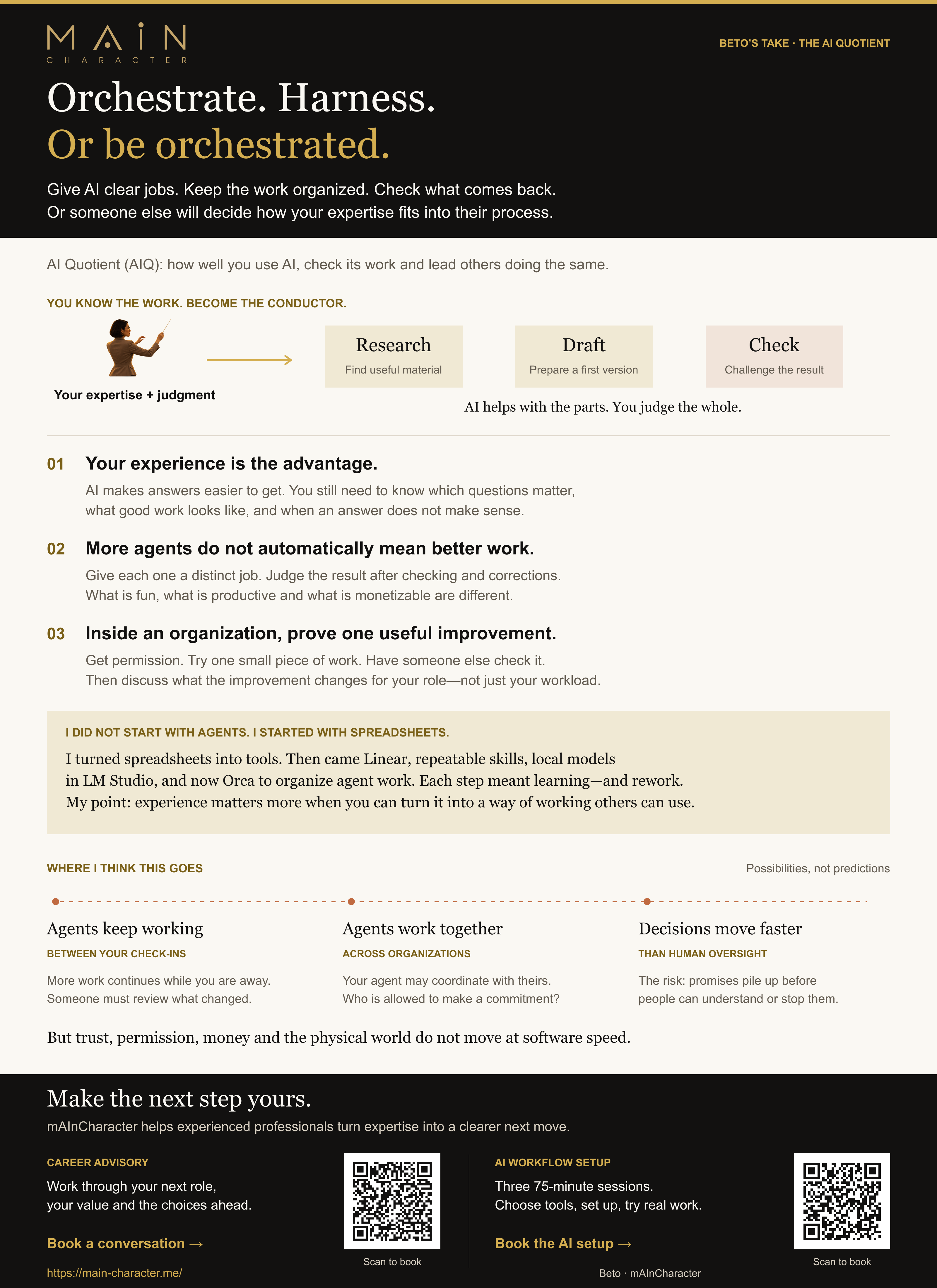
Thesis. Orchestrate. Harness. Or be orchestrated. Experienced professionals become conductors of AI-assisted work: they define the work, assign the parts, listen for what is off and decide when the result is ready. Your expertise should help write the operating rules, not become a cost inside somebody else's model.
Definition. The AI Quotient (AIQ) is how well you can put AI to work, check what it produces and lead others doing the same. It is a practical framework by Beto Cruz (mAInCharacter), not an IQ test, a score or a certification.
Structure. Twelve cumulative operating stages (AIQ 1–12: Context & Prompt Craft · Evidence & Judgment · Workflow Fluency · Tools from Expertise · Scheduled Workflows · Reusable Skills · Connected Systems · Model Routing · Goals & Long Runs · Agent Orchestration · Harnessed Reliability · Accountable Scale) and three conditional future horizons (AIQ 13–15: Persistent Delegated Teams · Agent-to-Agent Institutions · The Delegated Economy) that describe scenarios to prepare for, not levels to attain. Governance, permissions, review and a reproducible handover apply throughout.
Inside an organization. Five gateways, in order: Unit → Sponsor → Baseline → Reviewer → Mandate. Rehearse on permitted work, run one bounded pilot with an independent reviewer, then earn a wider, revocable mandate. Most organizations are barely experimenting, so the professional is usually the first person asking.
Key claims. More agents do not improve quality automatically; parallel work helps only when assignments are distinct and someone independent reconciles them. Fun, productive and monetizable are distinct. Done is not the same as right. The physical world, institutional consent, review, cost and human recourse slow the path for good reasons.
Method on the page. I do (Beto's lived example) · We do (a copy-ready evaluation prompt per stage for the reader's own AI) · You do (one small thing to try). Three illustrative situations (Isabella · stay or go; Amara · get recognized; Nathan · start a firm) and a four-step "Build your next step" tool. Nothing is scored, saved or sent to mAInCharacter.
Tags. AI Quotient · AIQ · AI fluency for executives · agent orchestration · conductor · knowledge-work democratization · organizational AI adoption · permission to pilot · bounded pilot · reviewer · mandate · reusable skills · MCP · local models · harness · career intelligence · mAInCharacter · Beto Cruz.
Source. Beto Cruz, mAInCharacter, September 2026. Public intelligence licensed CC BY-NC-ND 4.0; frameworks and interactive logic All Rights Reserved. Canonical: https://main-character.me/ai-quotient.html
What happens to the expert when more people can do the work?
Orchestrate. Harness. Or be orchestrated.
Your expertise should help write the operating rules — not simply become a cost inside somebody else's model.
It is called your AI Quotient — AIQ: how well you can put AI to work, check what it produces and lead others doing the same. Think of an experienced professional becoming the conductor. You know the score, give each section its part, listen for what is off and decide when the work is ready. AI can help perform the parts; your judgment keeps the whole thing coherent.
ByBeto Cruz · mAInCharacterStandpointSeptember 2026FormArticle · 12 operating stages · 3 future horizons · Build your next step
AudioAI with the AI QuotientAudio Overview generated with Gemini Notebook0:00/--:--
The Organization Leader | The Orchestra Conductor
Executive summary
Access to an answer is getting easier. Deciding what deserves to be done is not.
Expertise directs abundant intelligence. With enough compute you can keep exploring a problem from different angles. Someone still needs to know whether the answer makes sense. Access to a mixture of expert perspectives is not judgment.
Inside an organization, the wedge is permission to prove something. Not “find five customers” — find a recurring pain, secure a sponsor and permitted inputs, run one bounded workflow, compare, earn a wider mandate.
The skills build on each other and can be shared, but not skipped. Twelve of them, in the order I met them; someone on your team can cover one for you. Buying the next tool does not move you up.
The three situations are illustrative, drawn from our Career Arc work. Anything you select on this page stays on this page — no model is called, nothing is uploaded, no account is involved.
1
The thesis
The opportunity is not another tool. It is the work.
I work with high-performing professionals. People who have carried the deal, built the program, or become the person the room turns to when the answer is not obvious. They have put in the time. Their judgment has been earned.
So when I look at what AI is making possible, my question is pretty specific: where do these people sit in the work that comes next? Who is defining their role, their authority, and what they get paid for?
I believe this is the greatest democratization of knowledge work we have seen. Research, analysis, writing, and software are becoming accessible to people who could not previously assemble the time, team, or budget to produce them. But access to those capabilities does not settle who directs the work or keeps the value. That is where I think experienced professionals need to pay attention.
Orchestrate. Harness. Or be orchestrated. Someone is going to organize the work. I want the people who understand it to have a say in how that happens — not just be handed a new process and a revised expectation of their output.
Greg Isenberg's essay on AI-native services makes a useful shift in perspective: the opportunity can sit in delivering a completed outcome, not simply selling software that helps someone produce it. His emphasis on a repeatable unit of work, a rulebook and an accountable review layer is worth taking seriously. I read that and immediately thought about the other side of the transaction. What about the professional already inside the institution? The person whose expertise makes the service valuable in the first place?
There is a role here that I recognize: understand the situation, define the work, assemble the right expertise, and know when to challenge what comes back. The experienced professional becomes the conductor — you know the score, you give each section its part, and you listen for what is off. With agentic AI, that also means turning your method into repeatable skills and coordinating agents that can carry parts of the work.
The Neo comparison in The Matrix is hard to resist. You can call up a new combination of specialist roles, models, and tools and start working through a problem that would have been out of reach. With enough compute, you can keep exploring it from different angles. But someone still needs to know whether the answer makes sense. Access to a mixture of expert perspectives is not the same thing as judgment.
The opportunity: get much better at directing what you already know. We work with founders carrying twenty years of tacit knowledge in a handful of spreadsheets.
Beto · mAInCharacter
More agents earn their place only if they improve the accepted outcome.
Expertise sets the rules · the harness holds the work
Skill — a reusable method: the way you want work done, with examples, limits and checks. MCP — a standard way to connect a tool to an AI system; the connection is not the permission. Harness — the surrounding system that keeps track of assignments, separates changes, supports review, and lets you recover when a run goes off course. “Specialist roles” here means role-based assignments, not a model’s internal mixture-of-experts architecture.
2
My path
Here is how I got here.
I did not start with a plan to orchestrate agents. I started with spreadsheets.
I was taking spreadsheets and turning them into internal software tools. Vibe coding let me build things I previously would have needed someone else to build. That was exciting. Then I had to work out whether the tool actually did what the spreadsheet did, where it broke, and whether somebody besides me could use it.
Then I started using Linear to organize the work, setting up scheduled agentic tasks, and building workflows that could run again. A conversation with an AI was no longer enough. What was the assignment? What depended on it? Who was reviewing it? What happened if it failed while I was doing something else?
Skills came next: taking the way I wanted work done and making it reusable. I kept refining them, adding examples, broadening where they applied, and making the checks more specific. I did not want to keep explaining the same standard from scratch.
Creating MCP connections let agents work across more of the tools and information involved. That raised a different question: what am I actually allowing this agent to do? Reading a record, changing it, and sending it to someone are three different decisions.
Permissions, review and handover sit underneath every step.
Beto’s progression · not a universal chronology
Then I installed LM Studio and started integrating local LLMs. Now I was dealing with the actual machine: memory, capacity, model size, and which work belonged locally versus in the cloud. I also had to check where connected tools sent information. Having a model on my machine did not answer that for me.
In one supervised test, Qwen3.5 9B produced a coherent brief in Bionic from the material we gave it — and got the year wrong. That is a useful result to be honest about. It could produce the brief. I still needed to review the brief.
From there, I moved into plans and goals for longer runs, with multiple agents carrying different assignments. Now I am adopting Orca as part of the harness I use to coordinate that work. By harness, I mean the surrounding system that keeps track of assignments, separates changes, supports review, and lets me recover when a run goes off course.
In another test, a browser action reported a successful click. The page had not moved. A keyboard action did move it. So now, when an agent says it completed something, I want to see what actually changed.
These are the details that change how you work.
Why evidence sits at AIQ 2 — before any workflow, tool or agent
My team and I are still learning this. Each stage has been a compressed period of focus, and there has been plenty of rework. Luckily, an early investment-banking career prepared me for that intensity and attention to detail. But being willing to put in the hours does not mean I should keep spending them on something that is not producing value.
More agents do not improve quality just because there are more of them. What is fun, what is productive, and what is monetizable are very distinct.
3
Inside an organization
Most people are not clocking into an AI-native company on Monday.
“Find five customers and sell the service” is a founder’s starting point. It is not a realistic day-zero instruction for most professionals in a large organization.
They have a role, a manager, colleagues, policies, and work that still needs to get done. So let’s be specific about the entry point: find a recurring pain → secure a sponsor and permitted inputs → run one bounded workflow → compare the result → earn a wider mandate.
Five gateways · the professional and the organization
Every one of these is a door someone has to open.
Most organizations are barely experimenting. A small share of staff have Claude or Copilot; plenty have not adopted ChatGPT for work or Codex at all. So you are usually the first person asking — which means you are negotiating each gateway, not walking through one that is already open. What sits on each side is different, and so are the consequences of skipping it.
Reading as
The piece of work you pick
UnitOne recurring piece of work, small enough that you can check the result yourself.
If you skip itPick something too big and nobody can tell whether it worked. The pilot dies quietly — and you become the person whose AI idea failed.
You
The reconciled record of deals you have led — the pack you rebuild by hand each quarter.
The organization
Names the recurring work it is willing to have examined, and writes down how it is done today.
Who says yes — and to what
SponsorThe person with authority to approve the pilot and the information it may use.
If you skip itWithout one you are doing unsanctioned work with company data. The upside is yours to argue for; the downside is yours alone.
You
Your group head. Ask what you may use from the deal records before you use any of it.
The organization
Puts a name against the pilot and states which systems and records it may read.
What good looks like, agreed first
BaselineThe current method and its quality, recorded before anything is generated.
If you skip itWith no baseline any result can be waved away as a hunch — or oversold. Both cost you credibility you will need later.
You
How long the pack takes you today, and where it goes wrong. Write it down before you start.
The organization
Keeps the existing process running alongside, so there is something honest to compare against.
Someone who did not build it
ReviewerA colleague who checks the output and the exceptions — and whose time counts as part of the cost.
If you skip itReview your own work and the first serious error is found by a client or a regulator. At that point it is not a pilot, it is an incident.
You
A colleague outside your deal team reads the output against the source.
The organization
Funds review time and treats correction as part of the cost, not as overhead.
What this changes for you
MandateThe conversation about scope, recognition, resources or compensation, once the evidence exists.
If you skip itSkip it and the work is simply absorbed. You become the person who quietly does more for the same — and the capability leaves when you do.
You
What a bigger role and its terms would have to look like for staying to be the better option.
The organization
Decides whether proven capability changes a role, a grade or a budget — and says when that decision happens.
The internal value is not necessarily a new invoice. It may be a shorter review cycle, fewer avoidable errors, better continuity, or a clearer basis for a consequential conversation. Those are outcomes to measure, not benefits to assume.
Then have the conversation about what this changes for you. Name the person who can decide, and get specific about when that conversation happens. Otherwise, you may simply become very good at absorbing more work.
Two views of the same route
The five gateways are the sequence. The map is where you start it.
Left: the order inside an organization — pain, sponsor, pilot, evidence, mandate — the Unit → Sponsor → Baseline → Reviewer → Mandate gateways above, read as a route. Right: the same route placed on two axes, permission and checkability, so you can see which piece of work to open it with. Start where permission is in place and the result can be checked. Keep the pilot small.
The institution funds the learning. You prove what changed.
Earn the mandate before you scale it
Permission not yet in placePermission in place
Being able to check the result does not give you permission to act on it.
Start where permission meets proof
A better way to get the work done
Six frames. One question each.
From knowing the work to proving it works. This is a way of working, not a score or a six-step certificate.
01 / 06
01 / 06
Know the work before you hand any of it over.
Start with a recurring piece of work you understand well enough to judge. The conductor knows the score; that is what lets them give each section its part.
What would a good result look like here?
What would a good result look like here?
02 / 06
Agree what help is allowed.
Inside an organization the starting point is not five customers. It is a sponsor, permitted inputs and one problem worth proving you can solve.
Who can say yes to this pilot?
Who can say yes to this pilot?
03 / 06
Agree the job before you add agents.
Split the work only when the pieces are genuinely different — research, drafting, review. Someone still has to listen for what is off and bring it together. More players do not automatically improve the performance: in my close-narrative test, five assignments took longer to reconcile than three and were no more accurate.
Does another agent earn its review time?
Does another agent earn its review time?
04 / 06
Done is not the same as right.
A browser action once told me it had clicked successfully. The page had not moved. Inspect what actually changed, and count the review and correction time as part of the cost.
What changed — and how do you know?
What changed — and how do you know?
05 / 06
You still make the call.
Evidence can support a recommendation. It does not give anyone permission to send the message, commit the money or change someone’s record.
Who is allowed to decide this?
Who is allowed to decide this?
06 / 06
Show what improved. Then ask for more scope.
Bring back the accepted result, what it cost to produce, and the person who can keep it running. Then ask for the next specific piece of work — and what it changes for you.
What are you asking to take on next?
What are you asking to take on next?
4
Three illustrative situations from our Career Arc work
Three different people. Three different next steps.
Choose the situation closest to yours. Each shows what needs to be in place first, what comes next, and what depends on the work you choose. These people do not need identical tool stacks — they need the right skills covered, by themselves or by named people on their team.
Work out what staying is worth before comparing it with leaving.
Illustrative journey, not a client result.
Business Services · Growth / Reinvent
Isabella Romano-Duke
“If I am worth a Principal title somewhere, I want to know what staying is worth first.”
A restructuring VP with mandates, creditor relationships and two cycles of difficult work behind her. An outside approach has arrived. The question is not merely whether she can leave. It is whether the authority she already carries is recognized where she is.
I would start with what she has already built. Which mandates? What contribution? What responsibility is she carrying now? AI can help organize those receipts and challenge the case before she takes it into the room. Then map who can recognize that authority and on what terms. Price the outside opportunity, absolutely. But do not leave without knowing what staying is worth.
What needs to be in place first
AIQ 1AIQ 2AIQ 3AIQ 6AIQ 7AIQ 8
You make the call
No confidential employer or creditor material sent to external models or a recruiter without permission.
Turn a documented record into a credible, dated conversation about her grade.
Illustrative journey, not a client result.
Organization Leaders · Growth / Elevate
Amara Diallo
“My program briefs the board. My grade does not.”
Amara's program briefs the board of a multilateral institution. Her grade does not reflect that scope, and a freeze complicates the route forward.
First, affirm the record. Then map the room. Who can influence the decision? What does the freeze actually prevent? What is the formal timeline, and when is her next conversation with a decision-maker? A reusable briefing skill and a scheduled, reviewed workflow can help her keep that preparation current. She still needs to have the conversation and own the narrative.
What needs to be in place first
AIQ 1AIQ 2AIQ 3AIQ 5AIQ 6AIQ 7AIQ 8
You make the call
Personnel judgments and institutional commitments remain with authorized people; a model never infers hidden motives as fact.
Test whether the idea, the partners, the money and the plan hold together outside the platform.
Illustrative journey, not a client result.
Business Services · Venture / Entrepreneur
Nathan Okafor-Voss
“The track record is mine. The machine that produced it is not.”
Nathan is an MD considering a spinout. His track record is not the same thing as ownership of the platform that produced it.
His path goes further into orchestration. I would give separate agents defined work on the thesis, partners, capital logic, runway, and operating plan, using information he is entitled to use. Then somebody has to reconcile the answers. Does the operating plan fit the capital? Have the partners committed, or have they expressed interest? What travels with Nathan, and what belongs to the institution? His reputation sits across all of it.
What needs to be in place first
AIQ 1AIQ 2AIQ 3AIQ 6AIQ 7–12AIQ 4AIQ 5
You make the call
No employer IP, investor solicitation, binding commitment or external message without appropriate rights and human authority.
5
Twelve cumulative operating stages
The stages build on each other. Buying the next tool does not move you up.
I have organized this experience into twelve operating stages: context and prompting; evidence and judgment; workflow fluency; tools built from expertise; scheduled workflows; reusable skills; connected systems; model routing; goals and long runs; agent orchestration; harnessed reliability; and accountable scale.
That sequence comes from how I have been doing the work. Your path may be different. Isabella does not need Nathan’s setup. And you do not have to carry every capability yourself. But if you are relying on someone on your team, name that person and make sure the capability is actually covered.
The foundations do not go away. Somebody still needs to define the assignment, check the sources, review the result, and know how to stop the workflow. Somebody else needs to be able to pick it up. Those responsibilities become more important as the system does more.
Start with a capability your work requires. Open Evaluate your AIQ to review a small example with your own AI, see what needs to be in place first, and choose a practical next step.
How to use the fifteen cards
Every card ends with a prompt you can paste into your own AI.
Each stage follows the same three beats. Read how I did it, hand the evaluation to your own AI with the prompt provided, then run one small thing yourself.
I do
Lived example
How the stage actually showed up in my work — including where it went wrong.
On the card · Lived example
We do
Prompt inside
A copy-ready prompt that asks your own AI — Claude, ChatGPT, Copilot, whichever you use — to assess only the evidence you choose to show it. No score, no upload to us.
On the card · Evaluate your AIQ
You do
One thing to try
A small, permitted experiment with someone to review it. The point is an accepted result, not a badge.
On the card · One thing to try
Use only work you are permitted to share, and nothing sensitive. The prompt runs in your own AI; nothing is sent to mAInCharacter. It produces a judgment to check, not a score or a certificate.
6
The pace
A new AI app, model or venture ships every two weeks.
It feels as though something changes every two weeks — and not just a frontier model. TypeSafe AI's Jev release puts structured decisions at the center of the interface. Instinct brings personal assistance into everyday messaging, including iMessage and WhatsApp. Orca brings multiple coding agents and their work into a shared operating environment. These are different layers changing at once, not three interchangeable chatbot subscriptions.
The pace makes it tempting to keep adding. My more useful question now is:
?
What does this let us do reliably that we could not do before — and what new responsibility does it create?
7
Three possible futures · from September 2026
Where I think this goes next.
Three conditional scenarios
Agents will talk. Who can commit?
From September 2026, I see three plausible horizons — not a promised timetable. Some sectors will move much earlier; others may never delegate particular decisions. The ominous part is not that agents talk to each other. It is the possibility that commitments accumulate faster than the people responsible can understand or challenge them. Each card below is a scenario to prepare for, with the physical or institutional constraint that slows it.
Conditional scenarios as of September 2026, not predictions.
Physical capacity · institutional consent · human recourse
From here to there
Nobody jumps from private experiments to autonomous agents.
The route inside an organization is slower and safer: rehearse on work you are permitted to touch, run one bounded pilot with a reviewer, then ask for a wider mandate on the strength of what was accepted. The horizons above only open on the far side of that.
Rehearse
Permitted work, your own desk
Reusable prompts and skills on records you already hold. Nothing leaves the room.
You decide
Pilot
One bounded unit, one reviewer
A sponsor, a baseline, permitted inputs, and someone who did not build it checking the exceptions.
Evidence
Mandate
Wider scope, still revocable
More work, a schedule, perhaps agents — granted on what was accepted, with authority that can be withdrawn.
You are still the gold dot
8
Build your next step
Choose your situation. Say who can help. Leave with one thing to try.
A tool for you to use · not a form for us
Work out your own next step. Here, on this page.
Four short steps. Start from one of the three situations or your own work, say who can help with each part, and leave with a plan in your own words. Nothing is scored, saved or sent — it is yours.
About four minutes
Stays on this page
A plan you can copy
1
Choose your situation
Pick one of the three situations, or choose a skill you want to look at in your own work.
2
What needs to be in place first — and who can help
Everything further along rests on a clear brief, checked evidence, a repeatable way of working, permission and a handover someone else can pick up. A colleague can cover a part — once you name them.
3
Choose one thing to try
Small enough to check. Information you are allowed to use, someone to review it, and a point where you stop. If you do not have permission yet, start with a read-only or made-up version.
4
Take the plan with you
Assembled from your choices above. Copy it into your own notes, or pick a skill and copy its evaluation prompt for your own AI.
Closing
You have spent years learning how the work gets done. That is something to build from.
This is why I keep coming back to the professional, not just the technology. You have spent years learning how the work gets done, where it breaks, and which questions matter.
Pick one recurring piece of work you understand. What would a better result look like? Who would need to agree? What can you test with the time and resources you actually have? Make the next step specific enough to do.
Your expertise should help write the operating rules — not simply appear as a cost inside somebody else's model.